painting
The Path
Acrylic on Canvas · 180 × 120 cm
Review
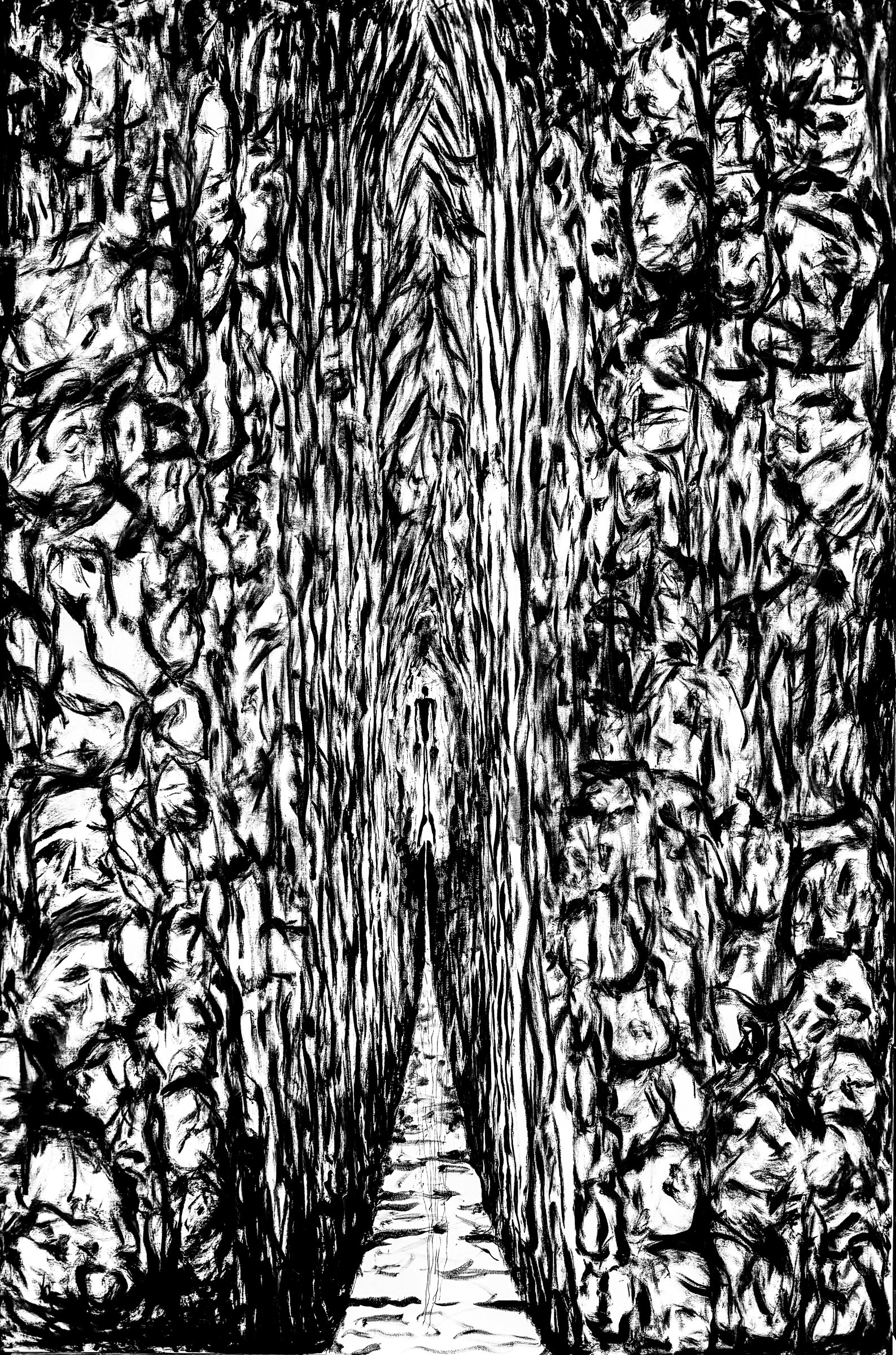
The first thing The Path asks is where the path actually is. The title promises a road, but the pale strip of floor takes up only the bottom fifth of the canvas. Above it the walls close in and the corridor doesn't run off to a horizon. It runs into a column of long, falling vertical strokes that rises to the top edge and folds into a herringbone near the top, like bark or a nave or water coming down. The way forward may not lead into the distance at all. It may lead up, or into a wall.
The walls on either side are made of faces. They don't announce themselves. They surface out of the dry-brush the way faces surface in rock or cloud. Several have closed eyes, and others are only dark sockets. They get larger and heavier toward the bottom corners, so the crowd is densest nearest the viewer and thins as it recedes. It is hard to say whether these are witnesses, ancestors, or just the weight of other people's opinions pressing on whoever walks through. Few, if any, seem to be looking at the figure.
The figure is easy to miss. It stands at the exact centre, thin, with arms hanging and a small head, inside a faint almond of lighter ground that works almost like a niche or a halo. Its legs don't end at the feet. They taper into a single thin line that keeps going down toward the viewer, as if the figure were throwing a long shadow back along the road it came by, or as if the figure and its road had been drawn in a single line.
That line has company on the floor. Fine vertical lines in permanent ink run down through the pale path and cross the short horizontal dashes that read as stones, ripples, or footfalls. They look at first like accidental runs of paint, but they are deliberate and fixed. They could be rain, threads, or the trace of something that passed this way before. Either way they pull downward, toward us, while the perspective pulls the eye away. Look closely and the canvas weave shows through almost everywhere. The black never fully covers the ground, so the whole crowd seems to be made of the same light the figure is walking toward.
The painting doesn't decide whether this is a pilgrimage or an exit. It only makes it clear that the walk is made alone, through everyone.