painting
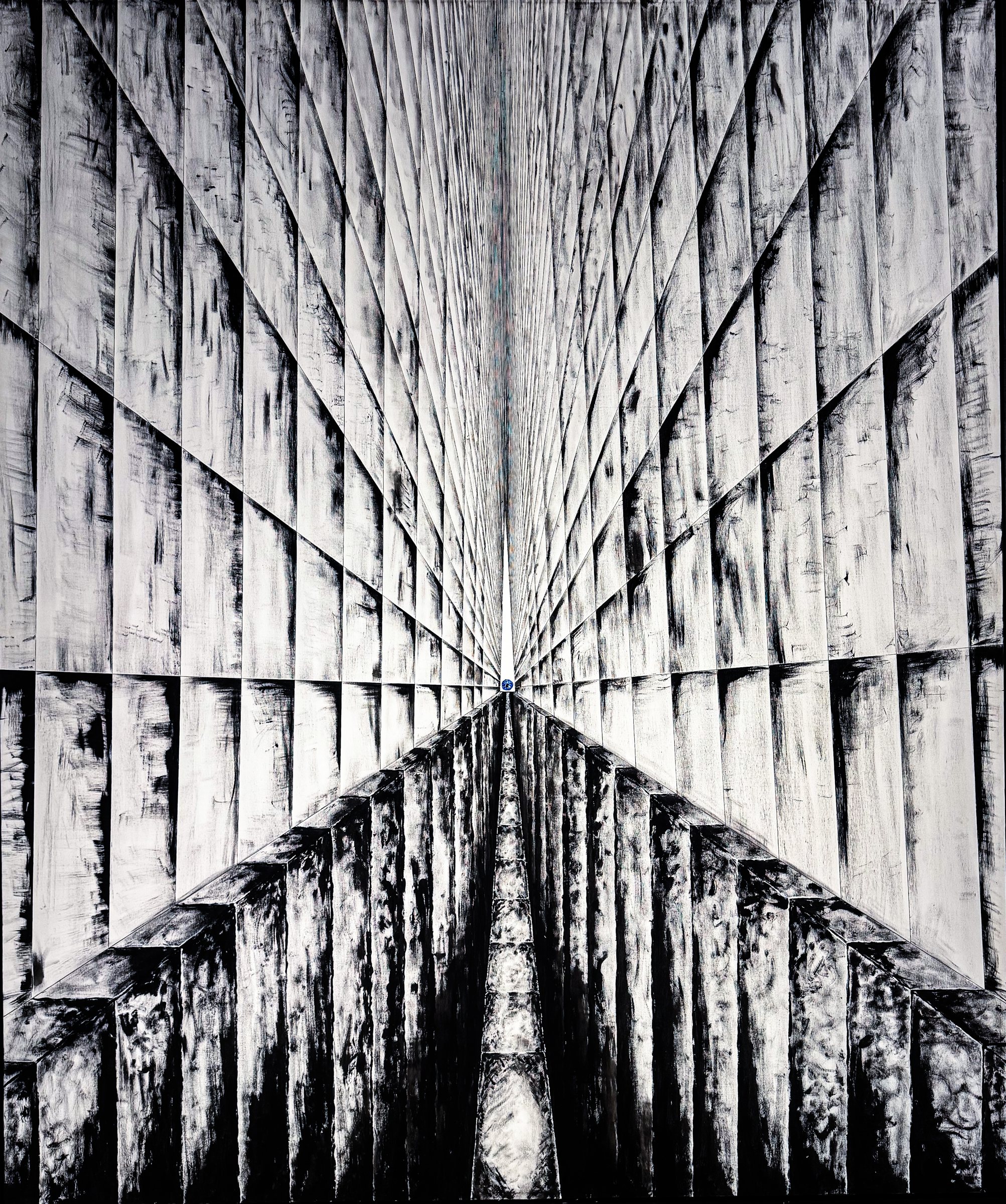
Straight and Narrow
Acrylic on Canvas · 160 × 180 cm
Review
Straight and Narrow is built with a ruler. Every edge in the walls is a crisp straight line, and every line obeys one vanishing point at the centre of the canvas. The panels of the side walls are tall and rectangular, stacked in rows that shrink as they recede, and inside each one the paint has been dragged downward in dry, streaky black, so that the cleanliness of the geometry is roughed up by weather. The ceiling is different again. It dissolves into hundreds of fine converging lines, closer to strings or organ pipes than to architecture, and it gives the upper half a vibration the walls don't have.
The floor is where the picture becomes uneasy. On both sides, the ground is not flat but made of dark, heavy blocks that step down toward the middle like stairs or pews, so the space reads less like a hallway than a trench. Down the exact centre runs a narrow walkway of pale slabs. The slab nearest the viewer holds a faint lozenge of light, as if lit from somewhere we can't see.
At the vanishing point sits the detail that changes the whole reading. From a distance it reads as a blue dot or a small sphere. Up close it has radiating streaks and a dark centre, closer to an iris than a ball. Directly above it a tall white wedge rises from the vanishing point into the ceiling, a narrow column of untouched light that the eye at the end seems to be standing in.
The title's phrase usually describes a moral path, the narrow way that few find. The painting takes the phrase literally and then complicates it. The path is straight, and it is very narrow, but its geometry is so total that the viewer has no choice about where to look. The only free element in the whole system is the small blue eye at its end. It is the one thing in the picture that isn't drawn by perspective, and it may be the thing doing the looking.