painting
Self Reflection
Acrylic on Canvas
Review
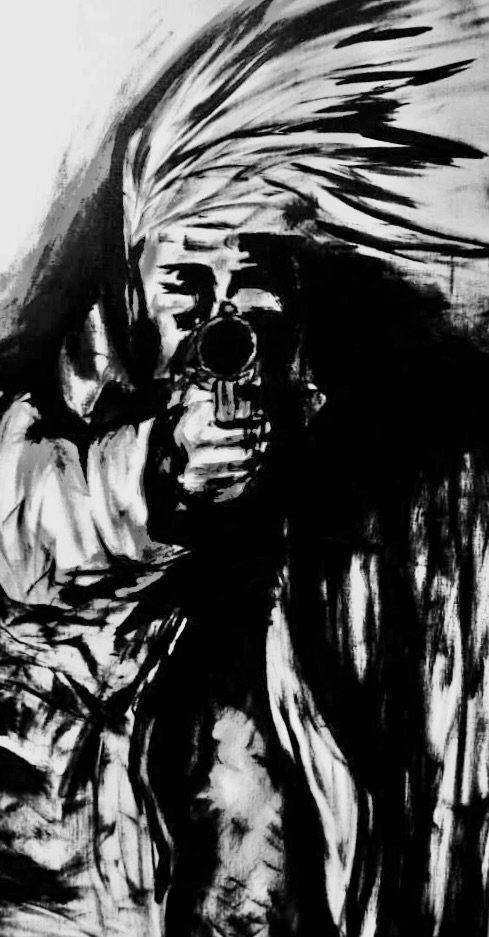
Self Reflection shows one figure and one gesture, and the gesture is aimed at us. An arm extends straight toward the viewer, foreshortened so steeply that the hand and the gun almost sit on top of the face. The barrel is drawn end-on as a black circle, with the small post of the front sight standing on top of it, and that circle lands exactly where the nose and the centre of the face should be. The face is still there around it: one eye squinting along the line of the barrel on the left, the other side of the face sunk into solid black.
The hair is the most energetic thing in the painting. It is pulled up and back from the head in long, sharp strokes that taper to points, like feathers or flames, or like hair caught in a blast of wind coming from the direction of the viewer. Against that motion the gun is completely still.
The body below the arm is barely there. The left shoulder and sleeve are suggested by a few pale strokes, and then the figure dissolves into long vertical streaks of black and grey that run to the bottom edge. The whole right side of the canvas is close to solid dark. The figure seems to emerge from that dark only as far as the arm, the face and the hair, the parts needed for the act.
The title is what reorganises the image. A self-reflection is usually quiet: a look in a mirror, a moment of thought. Here, if the painting is a mirror, the viewer is standing where the figure's reflection would stand, and the gun is pointed at the self. One reading is literal and grim. Another is closer to the way the phrase is used: honest self-examination as something that feels like being held at gunpoint, the moment when you stop looking away from yourself. The painting stages that confrontation in the simplest possible terms, and gives the viewer no way to step out of the line of the barrel.