painting
Reflexion
Acrylic on Canvas
Review
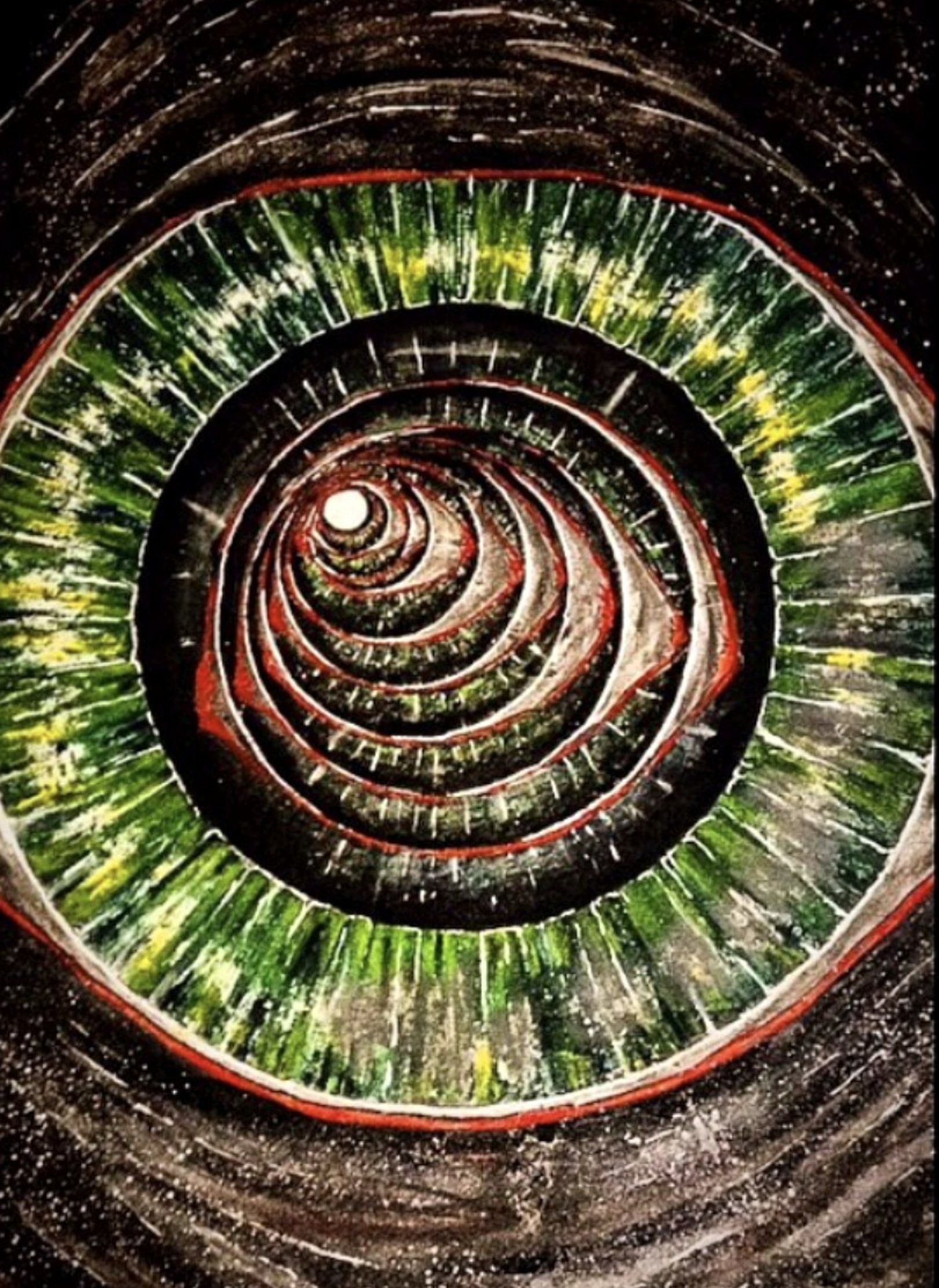
Reflexion begins as an eye and ends as a passage. The iris is a broad ring of green, built from radiating streaks with flecks of yellow and white pulled outward from the centre, and it is bordered on the outside by a thin white line and then a thin red one. The red line is one of the quiet decisions that makes the picture work. It separates the eye from the dark ground and gives the green its intensity.
Where a pupil should be there is a black ring, and inside the ring the painting starts to recede. A series of concentric ellipses steps inward, each one rimmed with red and white and marked with tiny tick-like strokes around its edge, like the teeth of a gear or the marks on a dial. The rings are not centred. They shift progressively toward the upper left, so that the tunnel bends as it goes deeper, and the last point, a small white dot, sits well off the middle. The effect is of looking down a spiral staircase or into a shell.
Outside the eye, the ground is a dark brown-black worked with long, curved white scratches that follow the shape of the iris, like the grain of wood or the rings of a tree, and spattered with fine white specks. It reads as both skin and space.
The title's spelling is worth noticing. Reflexion is an older form of "reflection", and the word holds two meanings: an image thrown back, and thought turned inward. The painting seems to take the second more seriously than the first. Nothing in it is mirrored; instead the gaze travels inward, ring by ring, toward a single point of light that doesn't sit where you expect it to. A reflex is also an involuntary response, and there is something involuntary in the way the eye follows the spiral down.
The white point at the end could be an exit, a source or a reflection on the surface of a wet eye. The painting doesn't settle which, and the off-centre placement suggests that wherever the tunnel leads, it isn't quite straight ahead.