
painting
Nilgiris
Review
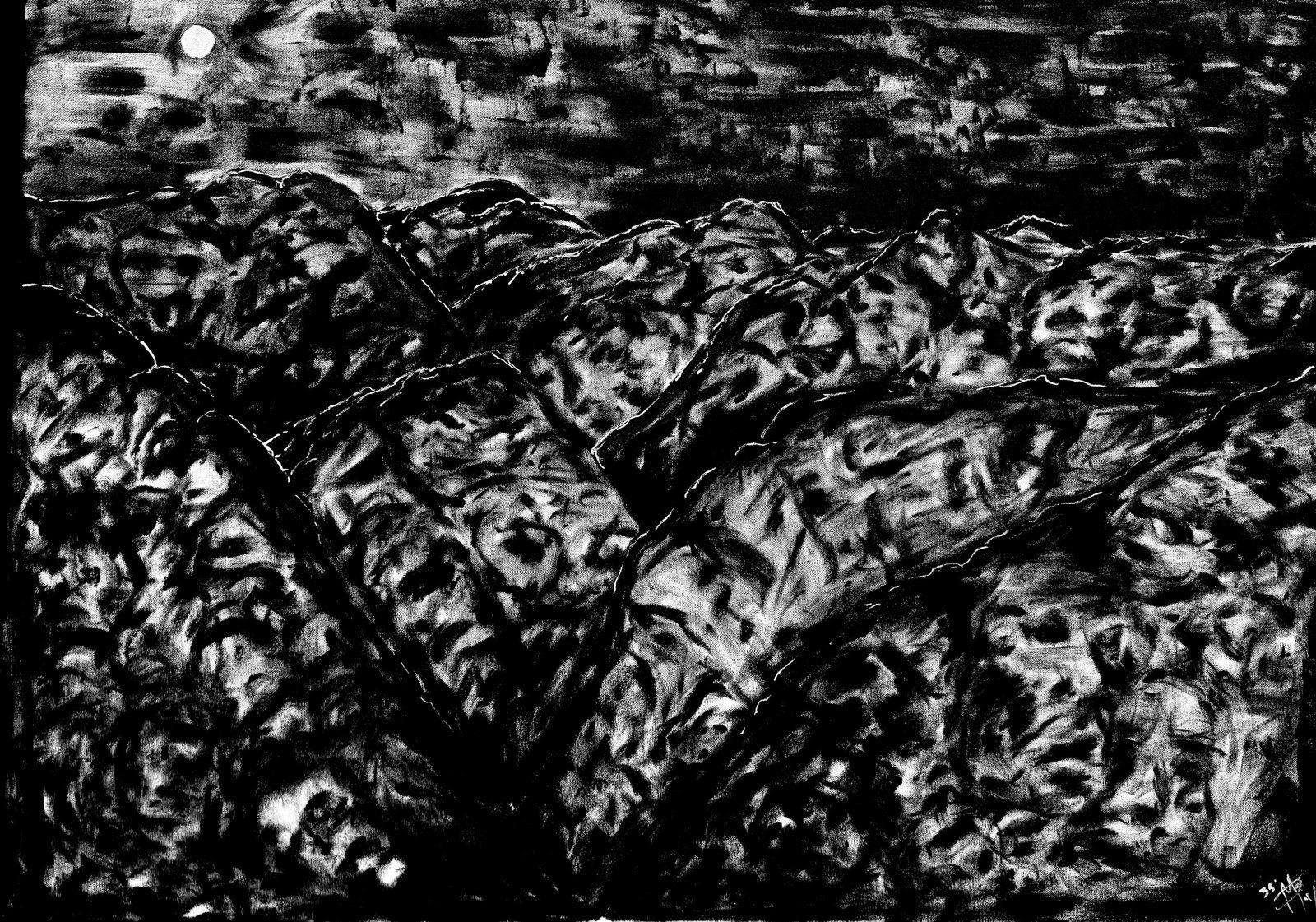
Nilgiris is a landscape painted almost entirely in black, with light used so sparingly that every touch of it counts.
The moon is small, sitting high in the upper left, a clean white disc with a faint smudge of halo around it. It is the brightest thing in the painting, but it lights very little. The sky beneath it is made of short horizontal dashes and smears, grey on black, that read as drifting cloud or wind. Below that, the ridges begin.
The mountains are built in overlapping bands that climb from lower left toward the right, and the device that makes them legible is a fine, broken white line running along the top of each ridge. It isn't a continuous contour. It flickers, stops and starts again, the way moonlight actually catches the edge of a hill. Without it, the slopes would merge into one dark mass. With it, the range acquires depth, fold after fold receding into the night.
Inside each slope, the brushwork is busy and unsettled. Short curved strokes, scrubs and scratches of grey sit on the black in no fixed direction, so the hills read as forested or rocky, and at moments almost as if they were made of the same turbulent material as the figurative paintings. In the lower right, the marks briefly gather into something like a pair of eyes and a nose, a face in the hillside, then fall apart again. It may be accidental. It is easy to see once noticed.
The foreground is nearly pure black, which places the viewer in shadow, looking out from a dark slope toward lit ridges.
In the lower right corner the artist's monogram and a few figures are written in white, the only lettering in the picture.
The title names a real mountain range, but the painting is not a topographical record. It is about the experience of a landscape at night, when the eye has only edges to go on and has to supply the rest. What it supplies, judging by the restless hillsides, is not entirely peaceful.