painting
Lost
Acrylic on Canvas
Review
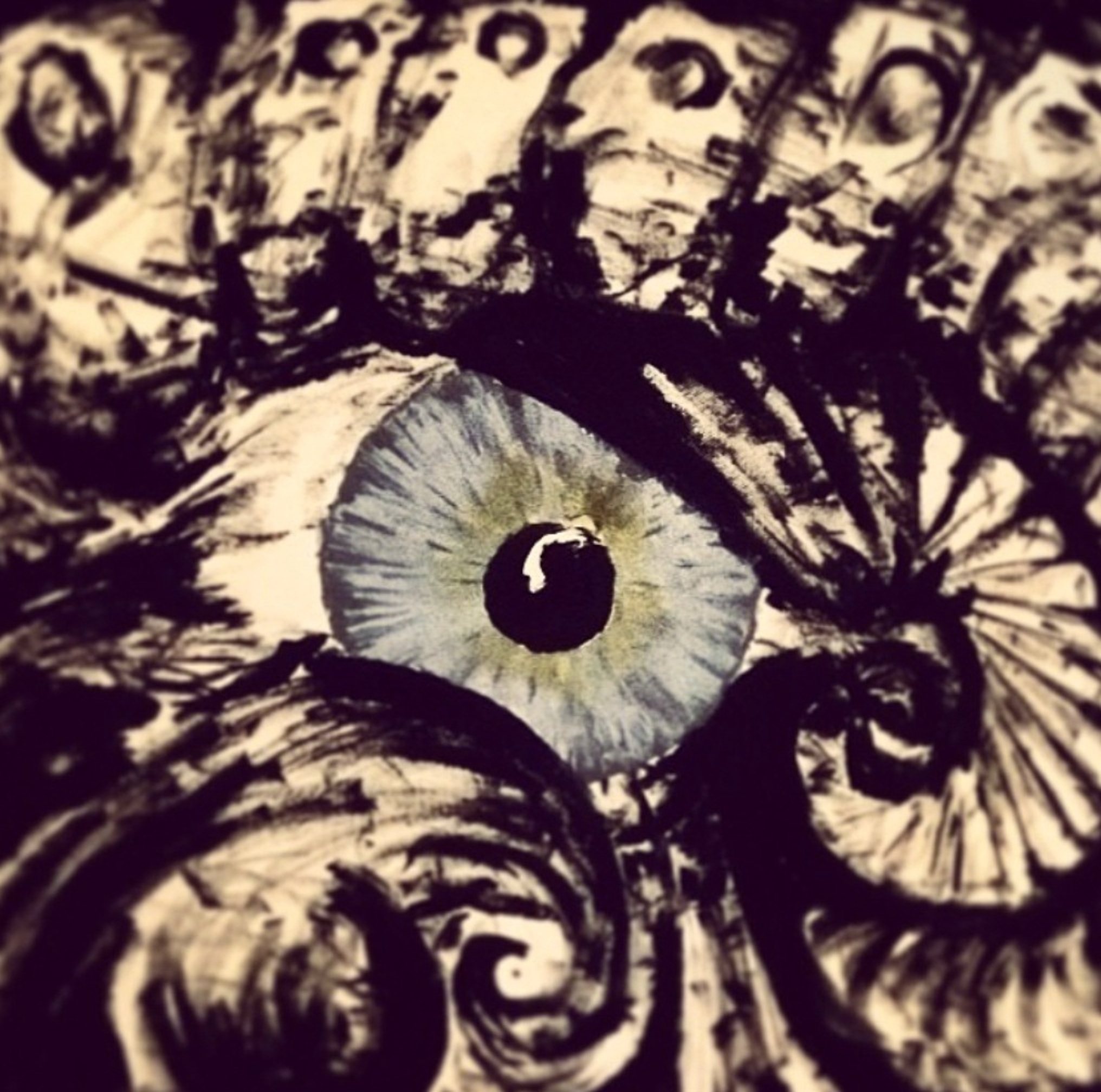
Lost is organised around a single eye that is calmer than anything around it. The iris is a pale grey-blue, almost silver, built from fine radiating streaks, with a ring of olive green and ochre closing in around the pupil. The pupil is a solid black disc, and on its upper edge sits a thick, hooked white highlight, not a neat round catchlight but a curl, like a reflection of a window or a figure. It is the brightest mark in the painting.
The eye has no clear lids. Heavy black curves sweep above and below it, but they don't close around it the way an eyelid would. The eye seems to float in the field rather than belong to a face.
Across the top of the canvas runs a band of faces. They are crowded shoulder to shoulder, each one reduced to a ringed eye socket, a suggestion of nose and a blur of jaw, painted in warm cream against black. None of them is distinct enough to recognise. Several seem turned slightly away. They read like a crowd seen from the edge of memory, present but unfocused.
The lower half is a different language. Black and cream strokes curl into scrolls and spirals, like breaking waves or the volutes of carved ornament, and at the right a fan of straight radiating lines opens like a shell or a pleated fan. These forms are more decorative than anything else in the picture, and they give the bottom of the canvas a turbulent, rolling motion.
In the photograph the whole image carries a warm sepia cast, so that the whites read as cream and the blacks as deep plum. The iris is the only cool colour.
The title invites a reading about disorientation, and the painting supports it quietly. The eye is clear and open, the surroundings are churning and indistinct. Being lost here isn't a matter of darkness; it is a matter of not recognising anything you can plainly see. The faces don't help. The patterns don't lead anywhere. The eye keeps looking, steady, at the one place none of them occupy: the viewer.