painting
Found
Acrylic on Canvas
Review
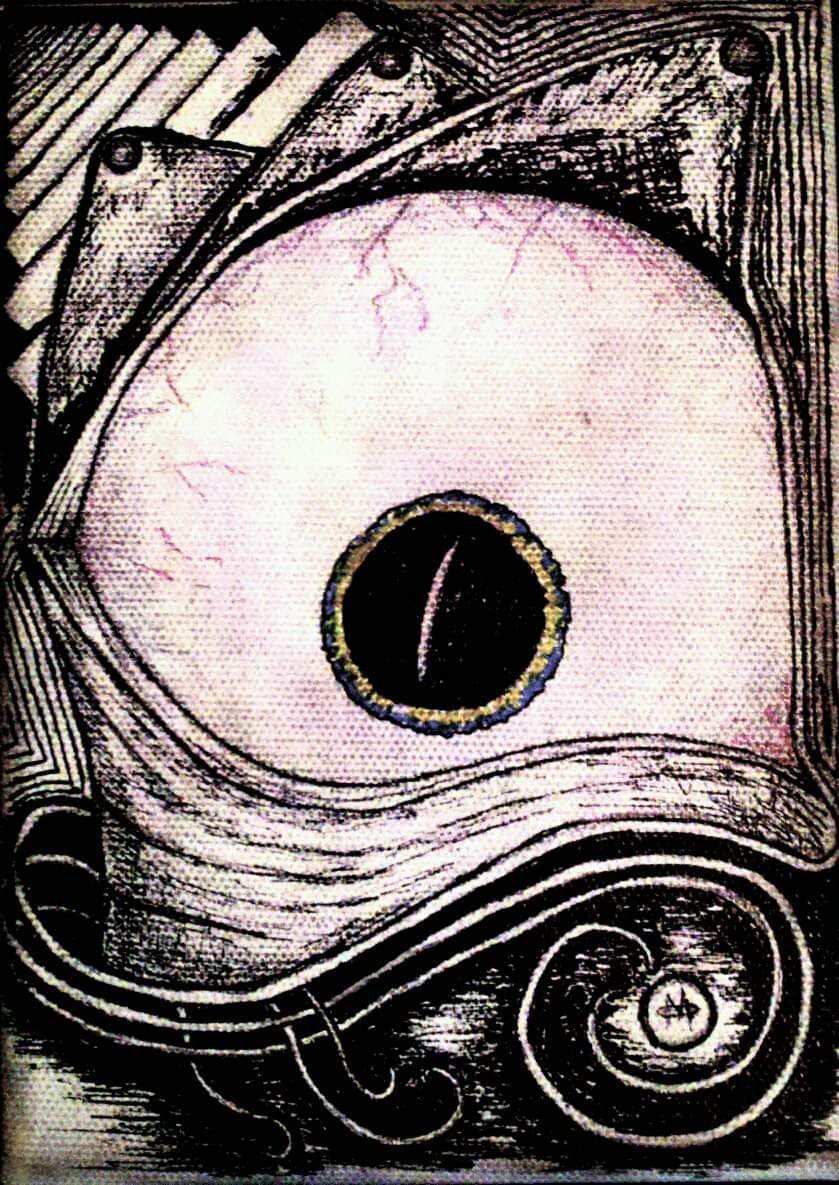
Found is an eye that has been built as much as painted. The sclera fills most of the canvas, a pale field tinted faintly pink and crossed by a few fine red veins, mostly near the top, the only sign of strain in an otherwise composed image. In the middle sits the iris, small for the size of the eye: a black disc bordered with a ring of gold and a thin outer edge of blue. Inside the black, a single pale sliver runs vertically. It can be read as a reflection, or as the slit pupil of a cat or a reptile, and the painting allows both.
The eye is held in a frame. Above it, flat plates overlap like the leaves of a shutter or the panels of a hatch, each fixed with a round rivet at its corner. They are drawn with dense hatching and cross-hatching, close to the look of an etching. In the top left corner, a series of angled stripes reads like slats or the keys of some instrument. Down the left and right edges, the hatching becomes concentric chevrons, as if the frame were machined.
The lower lid is softer. It flows out from under the eye in a wide band of fine parallel lines, like wood grain or water, and curves away toward the bottom of the canvas. There, the waves break into spirals and loose tendrils. The largest spiral, in the lower right, winds inward to a small circle, and inside that circle is the artist's monogram. It is a neat placement: the signature sits at the very centre of the spiral, the point the whole lower half of the composition is turning toward.
Throughout, the canvas weave is visible, especially in the pale areas, giving the drawing a printed texture.
The title gives the image its emotional key. Found is not a joyful word here so much as a settled one. The eye has stopped searching; it is fixed, held in place by plates and rivets, and looking straight out. One reading is reassuring: to be found is to be finally seen. Another is less so: to be found is to be caught. The rivets and the slit pupil leave room for both.