painting
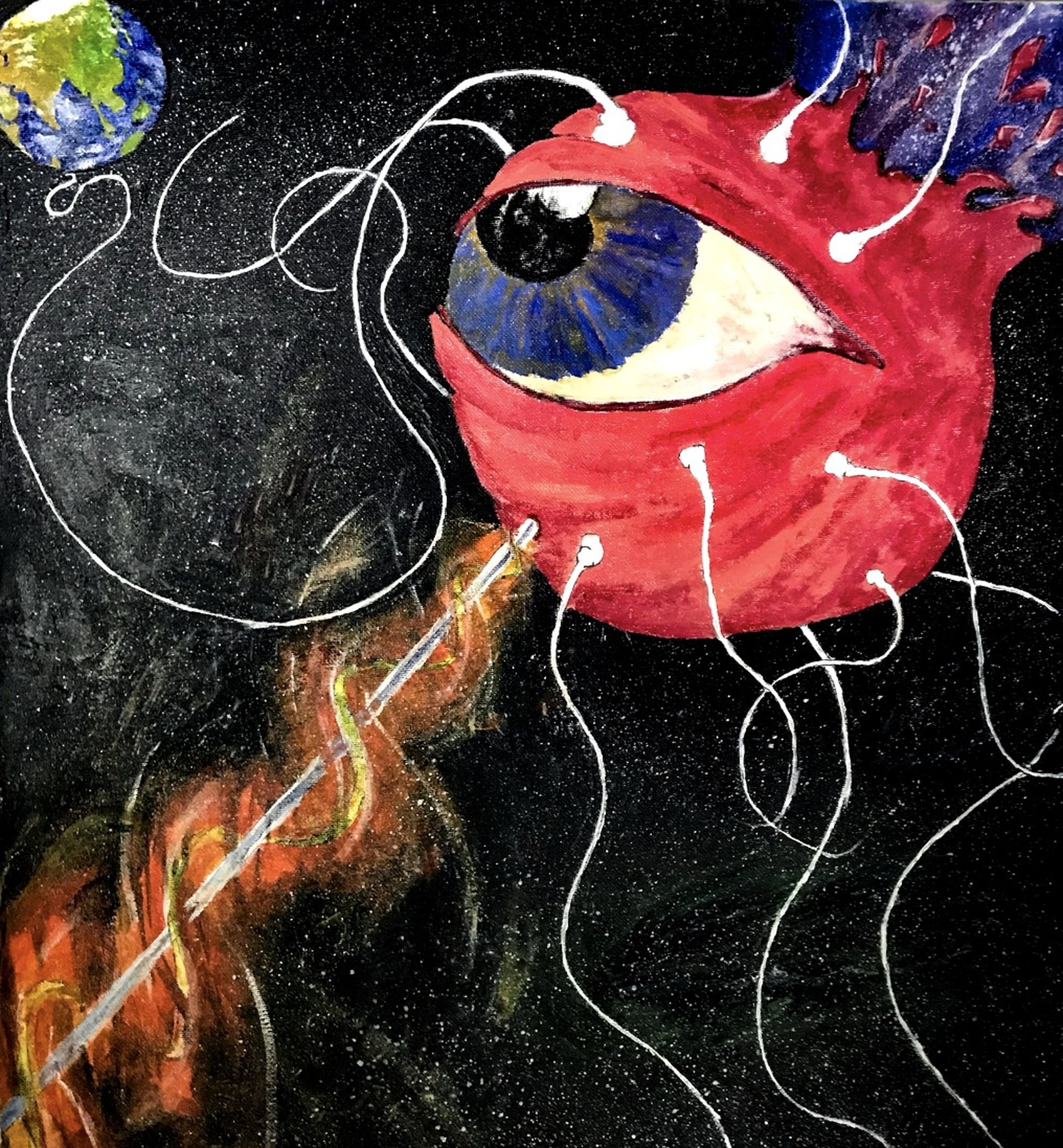
Birth of The New World
Acrylic on Canvas
Review
Birth of The New World sets one body against a field of stars. The body is a large red form, irregular, closer to an organ or a cell than to a head, and it holds a single enormous eye. The eye has a dark red lid line, a cream sclera, and an iris of deep blue with gold flecks near the pupil. The iris is pushed up and to the left in its socket, and that small decision gives the painting its direction. The eye is looking toward the upper left corner, where a small blue-and-green Earth floats on its own.
From the red body, white filaments run outward. Each one starts with a rounded white bulb where it touches the red surface and trails off into a thin line that wanders through the dark. They could be nerves, roots, or tethers. Given the title, they also look a great deal like sperm swimming toward an egg, or away from one. One of them makes a long loop up to the planet and curls beneath it, the only physical link between the body and the world it is watching.
At the upper right, the red surface breaks into a violet-blue cloud flecked with stars, and small red shards drift out into it like droplets. Whether the body is bleeding into space or space is seeping into the body is not clear.
The lower left is a different kind of event. A plume of orange and red, painted loosely like fire or smoke, rises toward the red body, and running through it diagonally is a straight silver rod, the only ruled line in the picture. A thin yellow-green line coils around the rod as it climbs, close to the image of a serpent on a staff, or a strand of DNA. The rod ends at the edge of the red mass.
The black ground is spattered all over with fine white dots, a simple and effective star field that keeps the eye from resting.
The painting doesn't explain its biology. It lays out the parts of a creation story, an eye, a world, threads of connection, a column of fire, and lets the viewer decide which one is giving birth to which.