painting
17°
Acrylic on paper / pencil
Review
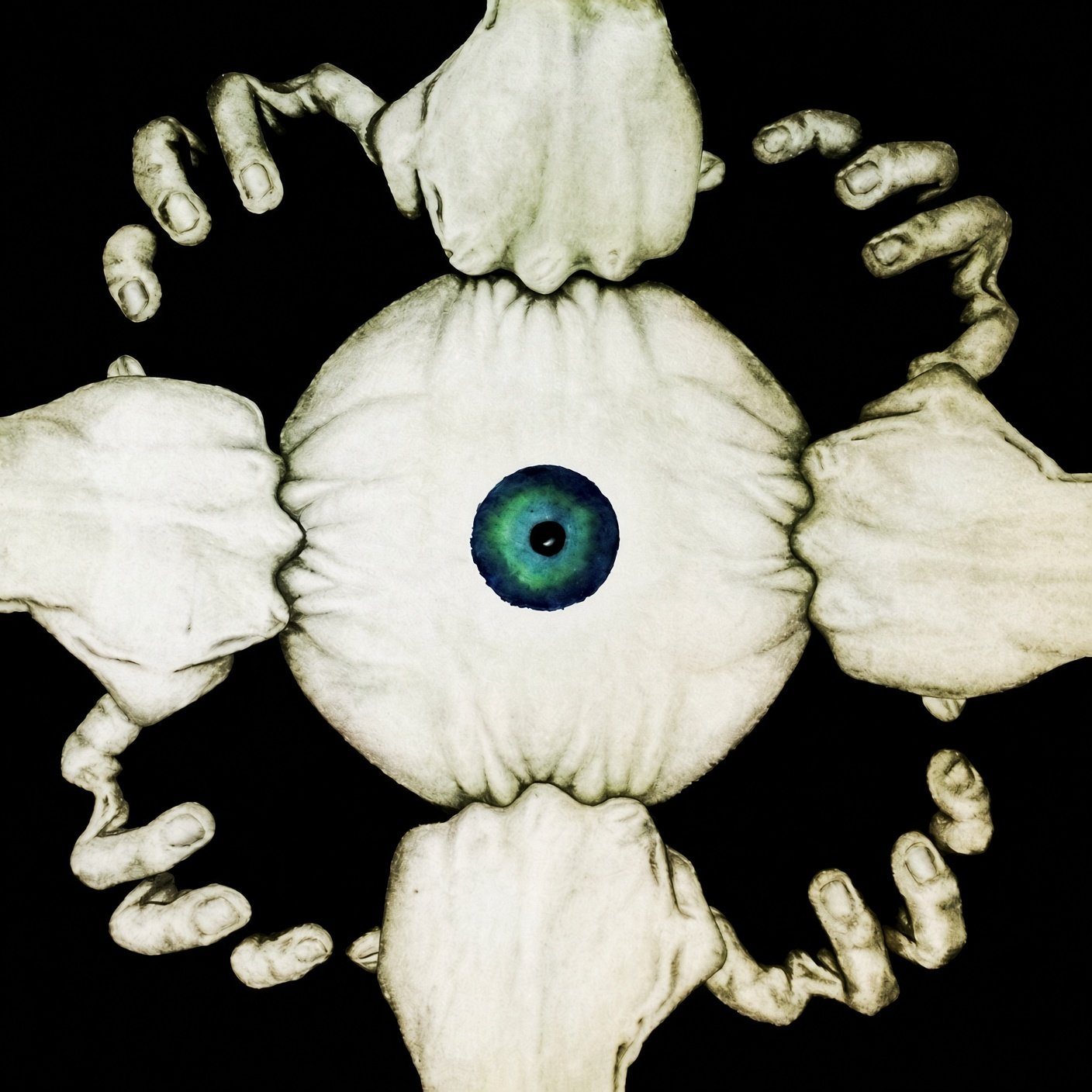
17° is built on a cross. Four fists arrive from the four edges of a black ground, top, bottom, left and right, and each one presses its knuckles into a pale, swollen sphere. Where the knuckles meet the surface it gathers into fine pleats, like cloth pulled by a drawstring or skin pinched between fingers. The pressure is visible, but so is its limit. Nothing tears.
The arrangement is close to, but not exactly, a quarter-turn repetition. Each hand is a slight variant of the others, and the fingers matter as much as the fists. From every hand, the loose fingers curl outward and trail around the sphere toward the wrist of the next, so that the hands form a broken ring. They read less as four attackers than as one body of grip, a circle of hands keeping something in place. Look closely at the fingertips: the nails are drawn with care, each with its own small highlight, the kind of detail that slows the eye down in a picture that otherwise reads instantly.
At the centre, the sphere holds one eye. It is not drawn as an eye in a face, with lids and lashes, but as a disc of colour set into the pale surface: a ring of deep blue opening into green and turquoise, and a black pupil with a single white point of light. It is the only strong colour on the canvas, and it sits perfectly still while everything around it pushes.
The title adds a question without answering it. Seventeen degrees could be a temperature, a tilt, an angle of view. Nothing in the image is tilted. The cross is upright and the eye stares straight out. Perhaps the degree is the small amount of give the sphere allows under pressure, or the angle at which a person is turned by the hands around them. The painting leaves the number hanging.
What stays is the ambiguity of the grip. The same gesture could be a fist, a hold, or a cradle, and the eye at the centre gives no sign of which it is experiencing. It simply keeps looking.